
Practical AI at Street Youth Ministry: From Messy Messages to Useful Data
AI becomes useful when it has a job to do, clear boundaries, and someone paying attention.
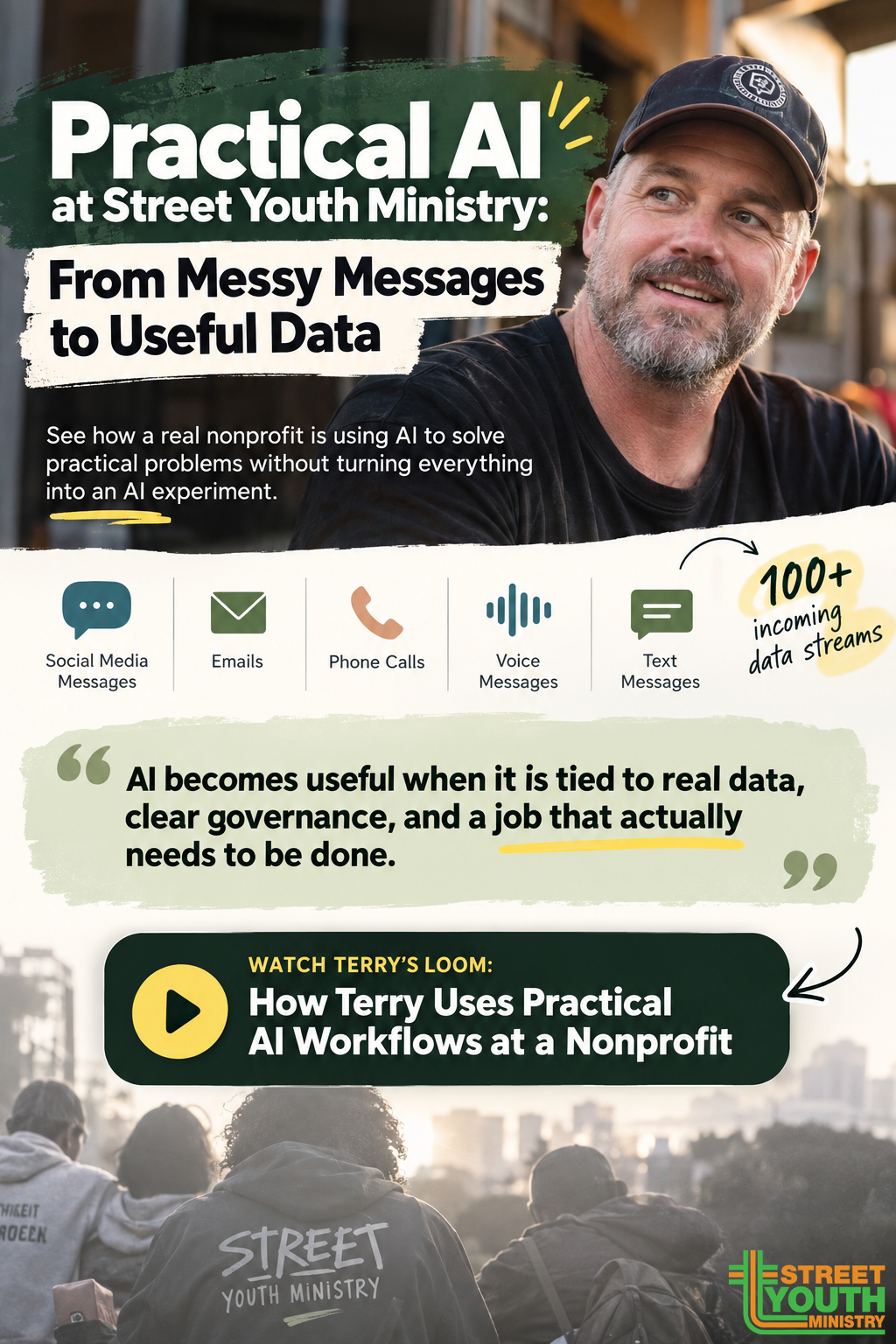
AI becomes useful when it has a job to do, clear boundaries, and someone paying attention.
AI can sound complicated, expensive, and risky. At Street Youth Ministry, Terry is taking a much more practical approach: use AI where it solves a real problem, define the rules, and keep humans involved.
This isn't a polished AI demo or an AI avatar. It is a real nonprofit workflow built around the everyday communication and data challenges of serving homeless young adults.
Start With the Framework
Terry's basic philosophy is simple: AI has to put up or shut up.
Generative AI is powerful, but it becomes useful when it operates within a framework that defines:
- Data: What information is going in?
- Governance: What is the AI allowed to do?
- Boundaries: What should it never do?
- Privacy: How is sensitive information protected?
- Cost: Can the organization afford to run it?
- Stability: Will the technology and API still be available?
For Street Youth Ministry, the goal is not to build something flashy. The goal is to make useful work faster, more consistent, and affordable.
Finding the Opportunity in Everyday Communication
About a year ago, the team started looking at the organization's actual problem sets and identified more than 100 incoming data streams.
Those streams include:
- Social media messages
- Emails
- Phone calls
- Voice messages
- Text messages
Much of that communication arrives without much structure. Someone may simply send a message or leave a voicemail, and the organization still needs to understand what happened and what should happen next.
That's where AI can help.
The team defines the information coming in and the information they want coming out. AI can then classify and structure the communication, producing things like:
- Message summaries
- Caller or contact type
- Intent to engage
- Standardized phone numbers
- Standardized email addresses
- Other structured case information
The result is a messy communication becoming a usable case file.
Simple AI Instead of Complicated AI
The system isn't built around autonomous agents making decisions on their own.
It's a single-pass workflow.
Incoming information is placed into a structured JSON record. The AI receives the new information along with the overall prompt and instructions for each field. It returns structured information that is written back into the system.
There are now approximately 15–16 workflows operating this way, often costing only pennies or less per record.
And importantly, humans remain in the loop.
The team knows AI can get things wrong. It can misclassify information, make assumptions, or occasionally invent an answer. That's why the workflow verifies the output and allows a person to review it before action is taken.
One Prompt Can Change the Workflow
Another advantage is maintainability.
When the team discovers that a workflow needs to behave differently, they don't necessarily need to rebuild the software. Often, they can change the instructions.
A classification rule can be strengthened. A particular type of message can be handled differently. A new instruction can be added to the prompt.
The workflow stays the same while its behaviour improves.
AI Beyond Text
Because the AI system is multimodal, Street Youth Ministry can also use images as inputs.
For example, workflows can evaluate photos for:
- Quality
- Framing
- Composition
- Context or likely location
- Appropriate calls to action
AI is also being used to proofread content, including prayer requests, while checking for specific policy requirements such as avoiding the names of young children.
The Bigger Lesson
The entire system runs on one codebase and one API for under $10 a month, and it has been operating for roughly nine months.
The important lesson isn't that every nonprofit needs to copy this exact system.
It's that useful AI doesn't have to begin with a huge budget, a complicated agent, or a futuristic vision.
It can begin with a real problem.
Define the data.
Define the rules.
Build a simple workflow.
Keep humans involved.
Measure whether it actually helps.
Then improve it.
Street Youth Ministry is continuing to expand these workflows with help from interns and feedback from the team. AI is becoming part of the infrastructure, not the mission itself, but a tool that helps the mission operate better.
See how a real nonprofit is using AI to solve practical problems without turning everything into an AI experiment. Watch Terry’s Loom: How Terry Uses Practical AI Workflows at a Nonprofit
Print & PDF Document Assistant
Street Youth Ministry Hub Publication
This document is styled for printing and PDF generation with a dedicated SYM header, 2-column photo layout, and donation callout.
💡 Preview Environment Tip:
If your browser security settings sandbox printer popups in the embedded preview pane, clicking "Toggle On-Screen Print Preview Mode" simulates the exact print view on screen, or use browser shortcut Ctrl+P / Cmd+P.
Support Youth Experiencing Homelessness
Scan below to give financially, subscribe to field updates, or join our dedicated prayer team: